
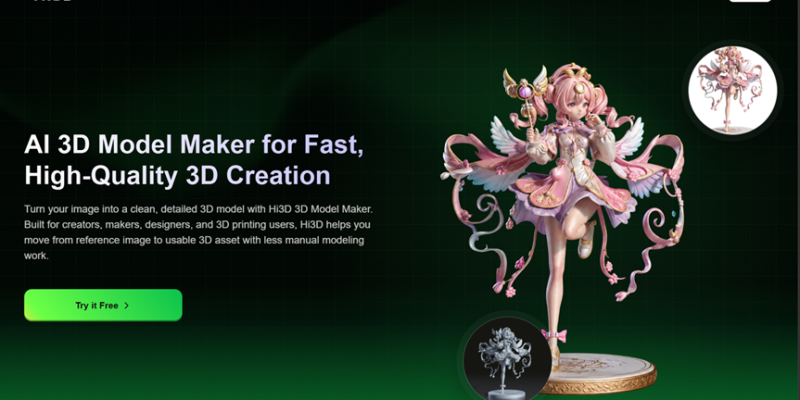
3D printing is changing the way people create, design, and produce objects in everyday life. From personal creative projects to professional prototypes, 3D printing allows digital ideas to become physical products with greater flexibility and efficiency.
However, as more people start using 3D printing, a new challenge appears: creating a printable 3D model is often more difficult than the printing process itself. Users need to transform ideas into models, improve visual details, prepare files, and adjust designs before reaching the final result.
AI is gradually reshaping this process by making 3D creation easier and more accessible. But a truly useful AI 3D tool should not only generate models. It should help users complete the entire journey from imagination to printing.
Hi3D is designed around this idea. Instead of focusing only on AI model generation, Hi3D combines creation and printing preparation in one workflow. Through image and text-based model creation, AI texture enhancement, model splitting, multi-color printing preparation, and smart arrangement, Hi3D helps creators move from concepts to printable objects more efficiently.
1. The Real Problem in 3D Printing: Turning Ideas into Printable Models
The development of AI has made creating 3D models faster than before. However, many users still experience difficulties after generating a model.
A digital model that looks complete on screen may still require additional preparation before it can become a successful print. Different users face different challenges depending on their experience level and creative goals.
1.1 Beginners Need a Simpler Way to Enter 3D Creation
Hi3D focuses on solving these practical problems by providing a more connected workflow that supports users throughout the entire creation process.
1.1.1 The technical barrier behind traditional modeling
For beginners, the biggest challenge is often not operating a 3D printer but creating a suitable model.Traditional modeling software provides powerful tools but usually requires professional knowledge. Users need to understand complex modeling techniques before they can create even a simple object.This creates a gap between creative ideas and actual production. Many people have unique concepts but cannot easily transform them into printable models.
An AI-powered AI 3D model maker approach helps reduce this barrier by allowing users to start with simple inputs such as images, concepts, or descriptions instead of building every detail manually.
Hi3D makes the first stage of 3D creation more accessible, allowing more people to participate in digital-to-physical creation.
1.1.2 Helping creators focus on creativity
The purpose of AI in 3D creation is not simply to generate models faster. More importantly, it allows creators to spend more time developing ideas instead of dealing with complicated technical operations.
By simplifying the early modeling stage, Hi3D helps users explore more creative possibilities and experiment with different concepts before printing.
1.2 Professional Users Need More Efficient Workflows
Experienced makers and designers often understand how to create 3D models, but they still spend significant time preparing files for printing.
1.2.1 Reducing repetitive preparation steps
A complete workflow may include improving model details, adjusting structures, preparing colors, separating parts, and arranging models before slicing.Without an integrated solution, users often need to move between multiple tools, which increases complexity and reduces efficiency.
Hi3D focuses on reducing these repeated steps by combining AI creation with printing-related preparation features.
1.2.2 Moving beyond simple model generation
Many AI 3D platforms focus mainly on producing digital assets. While model generation is important, it does not represent the entire printing process.A useful 3D model maker free experience should help users move beyond the creation stage and support the steps required to produce a real object.
Hi3D focuses on bridging this gap by helping users continue from generated models toward printable results.
2. Create Models Faster Through Image and Text-Based AI Generation
The first step of any 3D printing project is creation. Traditionally, this stage required users to build models manually or search for existing files.AI is changing this process by allowing creators to start from more natural forms of input.
Hi3D helps users transform visual references and creative concepts into 3D models, making the process more direct and flexible.
2.1 Transform Images into 3D Models
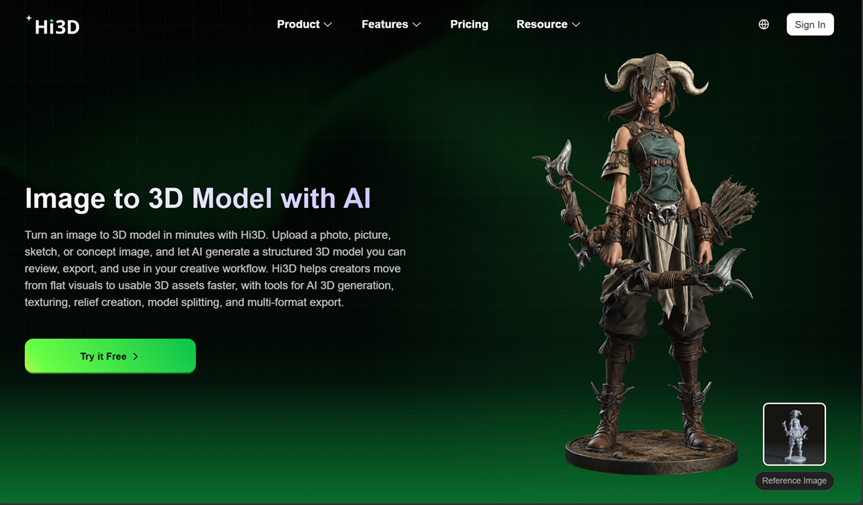
Many ideas begin with images. A personal photo, design sketch, illustration, or reference image can contain the basic concept of a future 3D object.However, converting a flat image into a complete 3D structure has always been a technical challenge.
2.1.1 Turning visual inspiration into physical objects
With picture to 3D model capabilities, Hi3D helps users transform image-based ideas into three-dimensional creations.Instead of manually rebuilding every shape, users can use images as a starting point and continue refining the generated model according to their creative needs.
2.1.2 Making image-based creation easier for different users
Image-based generation benefits both beginners and experienced creators.
For beginners, it removes the need to immediately learn complex modeling software. For experienced users, it provides a faster way to explore concepts and create early-stage designs.
Hi3D helps connect visual inspiration with practical 3D creation, making the transition from idea to model smoother.
3. Creating Models from Text Concepts
Not every idea starts with an image. Sometimes creators only have a written description of an object they want to create.
3.1 Turning descriptions into creative possibilities
Text-based generation provides another way to explore these concepts. Users can describe an idea and develop a model without first creating a detailed reference image.This approach makes creative exploration faster and gives users more flexibility during the design process.
3.2 Supporting a more natural creation experience
The advantage of AI creation is that users can communicate ideas in a way that feels natural.Instead of thinking about technical modeling steps first, creators can focus on the object itself, its appearance, and its purpose.
Hi3D helps transform these creative thoughts into a starting point for 3D development.
4. Enhance Generated Models with AI Texture Features
Creating the shape of a model is only one part of making an impressive 3D object. Surface details and visual appearance also influence the quality of the final result.
For many users, adding textures manually can become another difficult stage that requires additional design experience.
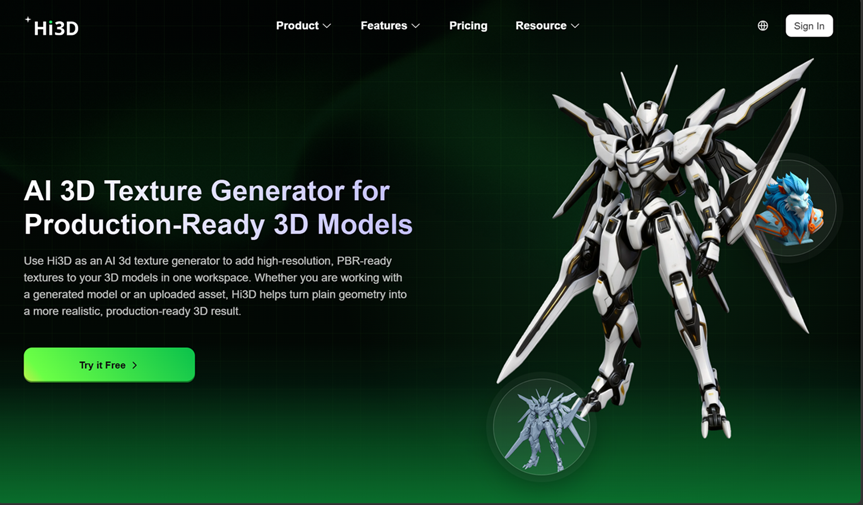
Hi3D provides AI-assisted texture features to help creators improve the appearance of their models.
4.1 Improving surfaces through AI assistance
A model with the correct structure may still need additional visual details to achieve the desired look.
Through AI texturing features, Hi3D helps users enhance model surfaces and explore different styles more efficiently.Instead of spending large amounts of time creating textures manually, creators can focus on adjusting the overall design direction.
4.2 Creating models closer to final printing goals
Texture improvement is especially valuable for creative models where appearance plays an important role.Characters, decorative objects, and display models often depend on surface details to create a stronger visual impact.
Hi3D helps users combine AI-generated models with improved appearance, creating designs that are closer to their intended final results.
5. Prepare AI Models for Real Printing with Hi3D’s Smart Tools
Generating a model does not guarantee a successful print. Before printing, users often need to solve practical problems related to size, structure, color, and arrangement.
Hi3D provides several features designed to make this preparation process easier.
5.1 Making complex designs easier to produce
Some models are too large or complicated to print as one complete object.
Hi3D’s Split-for-Printing feature helps users divide models into separate printable sections. For character-based models, it can separate components such as the head, body, arms, legs, accessories, and base. This reduces the need for manual model cutting and helps users prepare larger designs more efficiently.
5.2 Supporting easier assembly after printing
After separating a model, users still need a way to reconnect the printed parts.
Hi3D supports automatic connector generation, helping create assembly structures for different model requirements. Users can adjust connector settings based on their printing needs. This makes multi-part printing more practical for creators working on larger or more detailed designs.
6. Improving Results with Multi-Color Printing
Color can greatly influence the appearance of a printed object, but preparing multi-color models can be challenging.
Hi3D’s Multi-Color Printing feature helps users prepare models with printable color information. It can generate color regions, map colors to filament options, reduce unnecessary color fragmentation, and export 3MF files for printing workflows. This helps creators achieve better consistency between digital designs and physical prints.
6.1 Optimizing Printing Preparation with Smart Arrangement
Before printing, models need to be placed correctly on the build plate and prepared with suitable settings.
Hi3D’s Smart Arrangement feature helps simplify this process by suggesting print orientations, arranging parts efficiently, and supporting 3MF export with recommended slicer settings. This reduces manual preparation and helps users move more smoothly from AI-generated models to actual printing.
7. Why Hi3D Is Different from Meshy and Tripo
AI tools such as Meshy and Tripo have helped introduce more users to AI-assisted 3D creation. However, many platforms mainly focus on generating models.For users who want to print their creations, generation is only the beginning.
7.1 A Full Workflow from Creation to Printing
The biggest difference of Hi3D is its focus on the complete AI-to-print process.
Instead of stopping after creating a model, Hi3D continues with features that support texture improvement, model preparation, color workflows, and printing arrangement.This makes Hi3D more suitable for creators who want to produce physical objects rather than only explore digital models.
7.2 Designed for Practical 3D Printing Need
A successful 3D printing experience requires more than creativity. It requires a workflow that connects every stage.
Hi3D works as a complete 3D printer model maker solution by helping users move from ideas to printable results with fewer disconnected steps.By combining AI creation and printing preparation, Hi3D helps creators save time, simplify workflows, and focus on making better objects.
8. Celebrate Hi3D’s First Anniversary with 70% Off
The future of 3D printing is becoming more accessible as AI continues to improve the creative process. However, the most valuable innovation is not only generating models faster, but helping users complete the entire journey from concept to physical object.
Hi3D brings together AI model creation, texture improvement, printing preparation, and workflow optimization to make 3D creation easier for more users.
To celebrate its first anniversary, Hi3D is offering a limited-time promotion with up to 70% off, giving creators the chance to explore a more efficient AI-powered 3D printing workflow.
Whether you are a beginner discovering 3D printing or an experienced maker looking for a smoother creation process, Hi3D provides the tools to help transform ideas into reality.
Start creating with Hi3D today and experience a complete journey from AI concept to real-world print.