
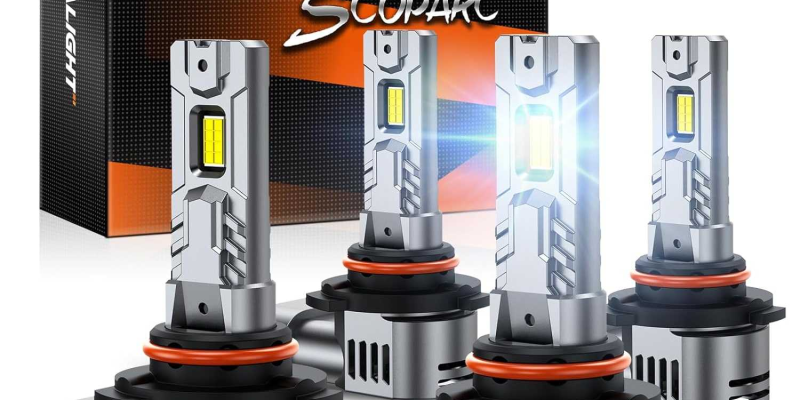
When replacing factory halogen bulbs, durability is just as important as brightness. A headlight can produce an impressive amount of light, but if it overheats, develops flickering issues, or fails prematurely, the upgrade quickly loses its appeal. This is particularly important for drivers who regularly travel at night, commute long distances, or drive in rain, dust, and changing temperatures.
SEALIGHT has developed several 9006/HB4 LED headlight bulb options with durability-focused features such as aluminum construction, active or passive cooling, compact designs, and varying levels of water resistance. On its official website, the brand offers multiple 9006/HB4 models, with claimed service lives ranging from several thousand hours to more than 60,000 hours depending on the series.
So, how well do SEALIGHT 9006/HB4 headlight bulbs actually perform in terms of durability? The answer depends on the specific model, installation conditions, and how effectively the bulb manages heat.
Why Durability Matters in an LED Headlight Bulb
LED bulbs generally generate less wasted heat than traditional halogen lighting, but they still produce heat around the LED chips and electronics. Excessive heat can affect components over time, potentially reducing light output or shortening the useful life of the bulb.
For that reason, durable LED headlight designs typically need to address three areas:
- Heat management: The bulb needs to move heat away from the LED chips and electronics.
- Environmental protection: Components should be protected from moisture, dust, and temperature changes.
- Electrical stability: The driver and internal electronics need to operate consistently without excessive flickering or premature failure.
SEALIGHT’s 9006/HB4 lineup approaches these requirements differently across its various product series.
Heat Dissipation Is a Major Strength
One of the most important durability features found in SEALIGHT’s 9006/HB4 lineup is its emphasis on thermal management.
For example, the SEALIGHT L2S 9006/HB4 model uses an aluminum housing, compression-resistant construction, and a high-speed cooling fan. SEALIGHT states that the combination is designed to improve heat dissipation and support a claimed lifespan of up to 65,000 hours.
The S2S model takes a similar active-cooling approach. According to SEALIGHT, it uses a 14,000 RPM cooling fan and a copper tube to reduce operating temperatures, while the manufacturer lists a 50,000+ hour lifespan for the model.
This illustrates an important point: advertised longevity isn’t simply about the LED chip itself. The surrounding thermal system plays a significant role in determining how consistently the bulb can operate over time.
Active Cooling vs. Fanless Designs
SEALIGHT’s 9006/HB4 range also demonstrates that there isn’t just one approach to durability.
Some models use fans to actively move heat away from the bulb. Others use fanless heat-sink designs. The SEALIGHT X1, for example, uses a compact fanless design with an aluminum heat sink and is advertised with a lifespan of more than 50,000 hours.
A fanless design has an obvious potential advantage: there is no cooling fan that can eventually wear out. SEALIGHT’s S1 series similarly uses a fanless construction and lists a service life of more than 5,000 hours on its specifications page, while its product description emphasizes the absence of fan-related failure or noise.
Meanwhile, fan-equipped bulbs can provide more active heat removal, which can be useful for higher-output designs.
Therefore, durability shouldn’t be judged solely by whether a bulb has a fan. The overall design, heat load, vehicle installation environment, and quality of the cooling system all matter.
Protection Against Rain, Dust, and Moisture
Automotive headlights operate in an environment where exposure to moisture and contaminants is unavoidable. Even when the bulb sits inside the headlight housing, condensation, rain, road spray, dust, and temperature fluctuations can all create challenges.
SEALIGHT addresses this with different waterproof ratings across its 9006/HB4 products. For instance, the L2S is listed with IP68 protection, while the S2S is listed as IP68 and the X1S as IP67.
These ratings are useful indicators of environmental protection, although drivers should remember that the bulb is only one part of the lighting assembly. The condition of the headlight housing, dust cover, seals, connectors, and installation also influence real-world protection.
In other words, a highly water-resistant bulb cannot compensate for a damaged or improperly sealed headlight housing.
How Long Can SEALIGHT 9006/HB4 Bulbs Last?
SEALIGHT’s claimed lifespan varies considerably by model.
The company’s current 9006/HB4 offerings include models advertised with service lives of over 5,000 hours, 6,000 hours, 50,000 hours, 60,000 hours, and even up to 65,000 hours.
These figures should be treated as manufacturer claims rather than a guarantee that every bulb will operate for exactly that number of hours in every vehicle.
Actual lifespan can be affected by:
- Operating temperature
- Hours of use
- Vehicle electrical conditions
- Headlight housing ventilation
- Installation quality
- Exposure to moisture and contaminants
- The particular SEALIGHT model being used
A driver who uses headlights for a relatively short period each day may experience a very different service life from someone who drives for several hours every night.
Build Quality Also Influences Longevity
Durability isn’t determined by the LED chip alone. The physical construction of the bulb matters as well.
SEALIGHT uses aluminum housings and heat-management components on several 9006/HB4 products. The X1, for example, combines an aluminum heat sink with a fanless design, while the L2S uses an aviation-grade aluminum construction and active cooling.
These materials and design choices can help transfer heat away from critical components while providing a sturdy structure for installation inside the headlight housing.
For drivers, this means it is worth looking beyond headline brightness figures when comparing LED bulbs. A well-engineered thermal and physical design can be more relevant to long-term reliability than a larger lumen number alone.
Installation Can Affect Durability
Even a well-designed bulb can experience problems if it isn’t installed correctly.
9006/HB4 bulbs should be installed in a compatible socket and positioned correctly inside the headlight housing. SEALIGHT specifically notes that 9006/HB4 and 9005/HB3 bulbs are not interchangeable simply because they look similar; their connectors, locking tabs, and typical applications differ.
Incorrect fitment can create several problems, including poor beam alignment, inadequate clearance, or difficulty maintaining the housing’s proper seal.
Before purchasing, drivers should therefore verify that their vehicle actually uses a 9006/HB4 bulb. SEALIGHT provides vehicle and bulb-size selection tools to help shoppers check compatibility.
Durability Doesn’t Mean Maintenance-Free
A long advertised lifespan doesn’t mean drivers should ignore the rest of the lighting system.
If a vehicle’s headlight housing develops condensation, its electrical system has voltage irregularities, or the bulb is installed incorrectly, the LED can be exposed to conditions outside its intended operating environment.
It is also worth checking both bulbs when one side develops a problem. Differences in brightness or color between the two sides can be distracting and may indicate that the pair is aging differently.
Regularly inspecting the headlight housings, connectors, and seals is a simple way to help preserve the performance of an LED upgrade.
Warranty Adds Another Layer of Confidence
Durability claims are more meaningful when a manufacturer also provides after-sales support.
SEALIGHT states that its products are covered by a one-year warranty from the purchase date, and its website also lists a 90-day return policy for unused and uninstalled products.
That doesn’t eliminate the possibility of an individual bulb failing, but it gives buyers an additional level of protection if they encounter a qualifying product issue.
SEALIGHT’s product pages also include customer reviews. For example, reviews on the L2S page include users discussing fitment, performance, and support experiences, while reviews on the X4 page include a customer reporting several years of use. Customer experiences are individual rather than controlled durability tests, so they are best considered supplementary evidence rather than proof of a specific lifespan.
Which SEALIGHT 9006/HB4 Design Is Best for Durability?
There isn’t a single answer because different drivers have different priorities.
If maximum heat management is important, a fan-cooled model such as the L2S or S2S may be attractive. If simplicity and the elimination of a mechanical cooling fan are higher priorities, a fanless option such as the X1 or S1 may make more sense. SEALIGHT’s published specifications show that the models also differ in waterproof ratings, cooling methods, and claimed service life.
The best choice should therefore be based on the vehicle’s available space, bulb requirements, expected usage, and the particular model’s thermal design rather than choosing solely by the largest advertised lifespan.
Final Verdict
So, how do SEALIGHT 9006/HB4 headlight bulbs perform in terms of durability?
Based on SEALIGHT’s published specifications, durability is clearly a major design consideration across its 9006/HB4 range. Aluminum construction, heat sinks, copper components, active cooling, fanless designs, and IP-rated environmental protection are used across different models to address the factors that can affect LED longevity.
However, the impressive lifespan figures should be viewed as model-specific manufacturer claims rather than a universal guarantee. Real-world longevity will depend heavily on installation, operating conditions, vehicle compatibility, and usage patterns.
For drivers looking for a replacement or upgrade, the most sensible approach is to verify fitment first, compare the cooling and protection features of the available models, and choose a bulb suited to the vehicle’s lighting system. Drivers interested in comparing the current 9006/HB4 range can visit SEALIGHT 9006/HB4 headlight bulbs or explore more options across the broader SEALIGHT automotive lighting lineup.
Ultimately, a durable headlight bulb isn’t simply one with the highest advertised hour rating. It is one that combines appropriate thermal management, environmental protection, reliable electronics, correct fitment, and suitable construction for the vehicle in which it is installed. SEALIGHT’s range offers several approaches to those requirements, giving drivers multiple ways to prioritize long-term performance.