

People searching for how to turn $100 into $1000 a casino are often hoping to find a betting pattern or game that can reliably multiply their bankroll. The honest answer is that no casino strategy can guarantee a tenfold return. Reaching $1,000 from a $100 starting balance is possible during a favorable session, but it requires unusual results, careful risk management, and the discipline to stop before winnings are returned to the casino.
The most useful way to approach this goal is not to treat it as a promise. Instead, view it as an exercise in understanding bankroll management, game selection, volatility, and profit protection.
What Turning $100 Into $1,000 Really Requires
Growing $100 to $1,000 means increasing the original bankroll by 900%. That is a significant target in any form of gambling.
To achieve it, a player normally needs one or more of the following:
- An unusually strong sequence of winning bets
- A large multiplier or bonus round
- Several smaller profits that are protected and gradually increased
- A willingness to accept substantial risk
- Enough discipline to stop after reaching the target
The difficulty is that casino games include a mathematical house advantage. The longer a person plays, the more that advantage has an opportunity to affect the result.
A longer session may create more chances to experience a winning sequence, but it also creates more opportunities to lose. This is why remaining in a game for as long as possible is not automatically a successful strategy.
The objective should be to manage the available balance carefully while recognizing that the entire $100 can still be lost.
Start by Defining the $100 as a Fixed Budget
The first step is deciding that the $100 is the complete session budget.
It should not be followed by another deposit if the balance reaches zero. Otherwise, the original plan quickly changes from risking $100 to risking $200, $300, or more.
Before beginning, decide:
- The total amount available
- The maximum stake per round
- The preferred length of the session
- A loss level that will end the session
- A profit level at which money will be withdrawn
These decisions are easier to make before emotions become involved.
A player who begins without limits may increase bets after losses, continue after reaching a reasonable profit, or deposit more because the next win feels close. None of those reactions changes the odds of the next game.
Bet Size Determines How Long the Bankroll Can Survive
A $100 bankroll can support very different numbers of rounds depending on the stake.
Ignoring any returns:
- A $1 wager provides up to 100 rounds.
- A $2 wager provides up to 50 rounds.
- A $5 wager provides up to 20 rounds.
- A $10 wager provides only 10 rounds.
- A $20 wager provides five rounds.
This does not mean smaller bets improve the mathematical return. They simply reduce the speed at which the full balance is exposed.
Someone who begins with $10 or $20 wagers may need only a brief losing sequence to lose everything. Using smaller stakes provides more room to observe the game and make controlled decisions.
However, the stake should not be increased merely because several rounds have been lost. Previous results do not make a future win more likely.
Choose Games Based on Risk, Not Appearance
Different casino games distribute results in different ways. The most visually exciting option is not always the most suitable for a limited bankroll.
Blackjack

Blackjack may offer a relatively low house advantage when it is played under favorable rules and with correct basic strategy.
It can be suitable for players who prefer structured decisions and more gradual balance movement. However, strategy does not remove the casino’s advantage, and rule variations can change the mathematics considerably.
Insurance and side bets generally introduce additional risk and can make a small bankroll less stable.
Roulette

Roulette is simple to understand, but the wheel format matters.
A European wheel has one zero, while an American wheel normally has both zero and double zero. The additional double-zero pocket increases the casino’s advantage.
Even-money wagers such as red or black may feel safer than betting on a single number, but they can still lose repeatedly. A sequence of five or six losses is completely possible.
Slots

Slots can produce the large multiplier needed to grow a small balance quickly, but that possibility usually comes with higher volatility.
A high-volatility title may produce long stretches of small or no returns before a bonus feature appears. The feature itself may also pay less than the amount spent waiting for it.
Players should check:
- Return to player
- Volatility level
- Minimum wager
- Maximum-win limit
- Bonus mechanics
- Whether the game has multiple RTP versions
A large advertised maximum win describes a theoretical ceiling. It does not indicate how frequently that result occurs.
Baccarat
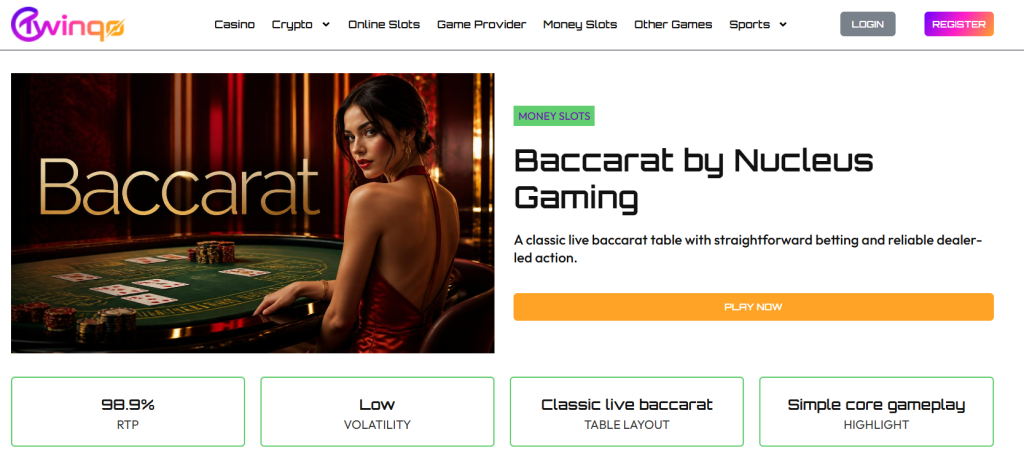
Baccarat is another simple table game. The Banker wager generally has a lower house advantage than the Player or Tie options, although a commission may apply to Banker wins.
The Tie bet can offer an attractive payout but usually carries a much higher house advantage.
Understand the Trade-Off Between Stability and Growth
A cautious approach may help a $100 balance survive longer, but it is unlikely to generate a tenfold return quickly.
An aggressive approach can reach the target faster, but it also makes losing the entire balance more likely.
This creates three broad styles of play.
Low-risk session management
The player uses small stakes and games with comparatively lower house advantages. The main objective is preserving the balance and taking modest profits.
This approach may move $100 toward $110, $125, or $150, but reaching $1,000 would require a long and unusually favorable sequence.
High-volatility play
The player chooses games with larger payout potential, such as volatile slots or concentrated roulette wagers.
The balance may rise quickly, but it can also disappear within a few rounds. This style provides the clearest path to a large short-term result while carrying the greatest chance of a complete loss.
Mixed-risk play
Some players begin with lower-risk wagers and increase the level of risk only after building a profit.
For example, a person might protect the original $100 after reaching $160 and use part of the $60 gain for a more aggressive attempt.
This does not create a mathematical advantage, but it can prevent the entire original budget from being placed at risk during the higher-volatility stage.
Do Not Rely on Betting Progressions
Systems such as Martingale encourage players to increase their stake after every loss. The theory is that one eventual win will recover earlier losses and produce a small profit.
The problem is that the stake grows rapidly.
Starting from a $2 wager, a losing sequence could require bets of:
- $2
- $4
- $8
- $16
- $32
- $64
The total amount required would already exceed a $100 bankroll before the final bet could be placed.
Casinos also apply maximum betting limits, and no system can guarantee that a winning result will arrive before the bankroll or table limit is reached.
Progressive systems change the size of the risk. They do not change the probability of the underlying outcome.
Protect Profits in Stages
One of the biggest challenges is not reaching a profit. It is keeping it.
A player may grow $100 to $180 and then continue because $1,000 still feels possible. If the balance returns to zero, the profitable part of the session becomes irrelevant.
A staged plan can provide clearer stopping points.
For example:
- At $150, consider securing part of the $50 profit.
- At $200, protect the original $100.
- At $300 or $400, decide whether the remaining balance is still worth risking.
- At the final target, withdraw rather than extending the session.
These figures are examples, not a recommended formula. The principle is to make profit-protection decisions before the balance reaches those levels.
An amount displayed in the casino wallet is still exposed to further wagers. A profit becomes meaningful only after it is withdrawn or removed from the playing balance.
Read the Withdrawal Rules Before Depositing
Withdrawal conditions can affect whether a successful session ends smoothly.
Before playing, review:
- The minimum withdrawal
- Processing times
- Identity-verification requirements
- Available payout methods
- Daily and weekly limits
- Pending periods
- Transaction fees
- Bonus-related withdrawal restrictions
Platforms such as Twinqo casino may appeal to players interested in crypto-based casino gaming and a broad selection of slot titles. As with any platform, users should review the current deposit limits, bonus terms, supported currencies, wagering rules, and withdrawal conditions before transferring funds.
A fast deposit does not automatically mean the payout will be equally fast. Verification and bonus requirements can delay access to a balance.
Be Careful With Casino Bonuses
A bonus can increase the playable balance, but it may also introduce wagering requirements.
For example, a player may deposit $100 and receive an additional promotional balance. Before any bonus-related winnings can be withdrawn, the casino may require the player to wager a multiple of the deposit, bonus, or both.
Important conditions include:
- Minimum qualifying deposit
- Wagering requirement
- Eligible games
- Maximum permitted bet
- Maximum cashout
- Expiration date
- Restricted payment methods
A bonus should not be treated as free cash. It is a promotional offer governed by conditions.
Players aiming to withdraw quickly may sometimes prefer playing without a bonus, depending on the available terms.
Recognize the Gambler’s Fallacy
A common mistake is believing that a result is due because it has not happened recently.
Examples include:
- Red must appear because black has won several times.
- A slot bonus must be close because it has not triggered.
- The next blackjack hand should win after several losses.
- A game is hot because it recently produced a large payout.
Random casino outcomes do not remember previous results. A losing sequence does not guarantee an approaching win, and a winning sequence does not prove that future rounds will remain favorable.
Decisions should be based on the budget and predefined limits, not on a feeling that the game is about to change.
Warning Signs That the Session Is Becoming Uncontrolled
The session should end when the player begins:
- Increasing stakes to recover losses
- Depositing additional money unexpectedly
- Ignoring the original stopping point
- Playing faster than planned
- Feeling angry or anxious
- Treating a win as guaranteed
- Continuing after reaching the profit target
- Borrowing money to stay in the game
Taking a break is not a missed opportunity. It is a way to prevent an entertainment activity from becoming a financial problem.
Is Reaching $1,000 Realistic?
It is possible, but it should be viewed as an uncommon short-term outcome rather than an expected result.
A player may reach the target through:
- A rare slot multiplier
- A strong table-game sequence
- A successful high-risk wager
- Several profitable stages
- A combination of good timing and luck
None of these outcomes can be scheduled or guaranteed.
The more aggressively a player attempts to force a tenfold result, the more likely the original balance is to be lost. The most realistic expectation is that the $100 is an entertainment budget that may produce a profit but can also be lost completely.
Common Mistakes to Avoid
The first mistake is making the target more important than the budget. A player who believes they must reach $1,000 may continue long after the session should have ended.
The second is increasing the stake after losses. This accelerates exposure without improving the underlying odds.
Another mistake is failing to withdraw after a strong run. A player who reaches $300 has already achieved a significant result from a $100 start, even though the original target has not been reached.
Finally, players should not rely on social media highlights as evidence of normal outcomes. Winning clips rarely show the deposits, unsuccessful sessions, or total amount wagered before the featured result.
Final Thoughts
Growing a $100 casino bankroll to $1,000 is possible, but there is no dependable system for doing it. Casino games retain a house advantage, and any attempt to pursue a tenfold return involves meaningful risk.
A controlled approach begins with a fixed budget, manageable stakes, suitable game selection, clear withdrawal rules, and an exit plan established before the first wager.
Players should protect profits as the balance grows and avoid increasing risk in response to losses. The most successful decision may not be reaching the full target. It may be recognizing when a session has produced a reasonable profit and leaving before that progress is lost.
Casino gaming should remain entertainment. Use only money you can afford to lose, play through legal and properly regulated platforms, and never treat gambling as a reliable source of income.