
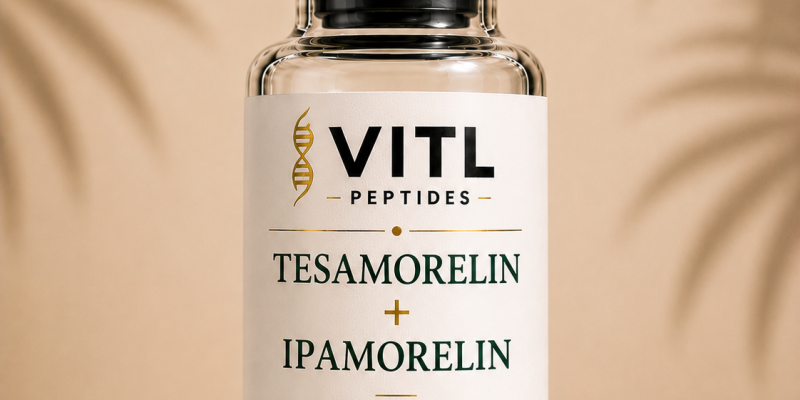
Dual-peptide formulations require a different evaluation approach from products containing a single research compound. A blend containing Tesamorelin and Ipamorelin brings together two peptides associated with distinct receptor systems, creating a formulation that can be examined in the context of multiple signaling pathways. Understanding those differences is essential before interpreting experimental findings or assessing the material for laboratory use. Researchers must also distinguish the properties of each individual peptide from the characteristics of the combined product. This includes reviewing the formulation’s identity, composition, analytical documentation, and batch-specific specifications.
The lyophilized Tesamorelin + Ipamorelin formulation is listed as a research-use-only peptide blend supplied in lyophilized form. Its product documentation identifies a 15mg strength and a specific batch reference. These details provide an initial basis for product assessment, but they do not replace the need to examine the available analytical records and confirm what the documentation establishes about the complete formulation.
Understanding the Two Peptides and Their Receptor Systems
Tesamorelin and Ipamorelin are not interchangeable compounds. Although both are studied in research involving endocrine signaling, they have different molecular structures and are associated with different receptor systems. Understanding this distinction helps researchers define experimental questions and avoid treating the blend as though it represents one uniform signaling mechanism.
Tesamorelin is a synthetic analog of growth hormone-releasing hormone (GHRH). Research involving this peptide commonly examines its relationship with the GHRH receptor, also known as GHRHR. This receptor belongs to the class B family of G protein-coupled receptors and is associated with intracellular signaling processes that include cyclic adenosine monophosphate (cAMP) pathways. Laboratory investigations may examine receptor activation, downstream signaling events, and the relationship between peptide structure and receptor response.
Ipamorelin is a synthetic pentapeptide investigated in relation to the growth hormone secretagogue receptor, particularly GHSR1a. This receptor is also known as the ghrelin receptor and belongs to the G protein-coupled receptor family. Its signaling characteristics differ from those associated with GHRHR, giving Ipamorelin a separate research context. Studies involving GHSR signaling may investigate receptor interactions, intracellular responses, and the molecular factors that influence signaling activity.
The central distinction is the receptor system associated with each peptide:
- Tesamorelin: A synthetic GHRH analog studied in relation to GHRHR activation and associated intracellular signaling.
- Ipamorelin: A synthetic pentapeptide investigated for its interaction with GHSR, particularly the GHSR1a receptor.
- Different signaling contexts: The peptides are associated with separate receptor systems, so their individual experimental profiles should not be treated as identical.
- Combined formulation: A blend introduces additional questions about composition, analytical identity, and the interpretation of results involving both compounds.
These distinctions provide a foundation for understanding the formulation, but they do not establish how the two peptides behave when combined. That question requires formulation-specific investigation rather than assumptions based on individual-peptide literature.
What Makes a Dual-Peptide Formulation Different?
A dual-peptide formulation contains two research compounds within one product presentation. This makes it different from purchasing and evaluating each peptide separately. The combined material must be assessed as a distinct research preparation, with attention to its declared composition, individual component identity, overall strength, and batch documentation.
Research findings from Tesamorelin-only or Ipamorelin-only studies cannot automatically be applied to a blend. The presence of both compounds may introduce additional experimental variables, including the relative amount of each peptide, formulation characteristics, and the analytical methods used to identify the components. Without adequate composition information, researchers should avoid drawing conclusions about the contribution of either peptide to an observed result.
A useful evaluation separates three levels of information:
- Individual compound information: Established molecular characteristics and receptor associations for Tesamorelin and Ipamorelin.
- Formulation information: The declared identity, total strength, component ratio, and physical presentation of the combined material.
- Experimental evidence: Findings generated using the actual blend under defined laboratory conditions.
This separation helps prevent an important interpretation error: assuming that evidence for two individual compounds is equivalent to evidence for their combined formulation. A blend needs its own documentation and experimental assessment.
Lyophilized Format and Product Specifications
Lyophilization is a freeze-drying process used to remove water from a material under controlled conditions. In peptide research supplies, this format is used to present material as a dry preparation rather than as a ready-to-use liquid. The physical format is one part of product identification, but it does not independently establish peptide identity, purity, stability, or suitability for a particular experimental method.
The product listing identifies the Tesamorelin + Ipamorelin formulation as a 15mg lyophilized powder for research use only. It also displays batch reference TI15-SUP-001 and a testing date of November 2, 2026. The listing presents a 99%+ HPLC purity statement, while the visible certificate section includes an endotoxin certificate link and indicates that the purity certificate preview will appear when the relevant documentation is attached. Researchers should therefore review the actual available records and confirm that each certificate corresponds to the supplied batch.
Important specifications to check include:
- Product identity: Confirm that the label and documentation identify both Tesamorelin and Ipamorelin.
- Total strength: Check the declared quantity of the complete formulation and the units used.
- Component ratio: Look for a documented amount or proportion for each peptide. Do not assume an equal split when the listing does not specify one.
- Physical presentation: Confirm that the material is described as a lyophilized powder.
- Batch reference: Match the batch identifier on the product, packaging, and analytical records.
- Research-use designation: Confirm the stated restrictions and intended laboratory context.
These details help establish whether the product information is sufficiently clear for procurement review and controlled research documentation.
Why Batch-Specific COAs Matter
A Certificate of Analysis (COA) provides analytical information associated with a particular product batch. It is more useful for quality assessment when the document identifies the material, states the batch reference, describes the analytical method, and reports the relevant results. A generic certificate or an undated quality statement may not provide enough information to verify the specific material received.
For a dual-peptide blend, documentation should address the formulation as a whole and, where applicable, provide evidence of the identity of each component. A purity result alone does not necessarily confirm that both declared peptides are present in the expected proportions. Researchers should also understand what the analytical method can and cannot establish.
A thorough document review should consider:
- Identity testing: Determine whether the analytical records support the identity of both peptides.
- Purity analysis: Review the reported result, method, chromatographic information, and any stated limitations.
- Component assessment: Check whether the documentation provides separate information for Tesamorelin and Ipamorelin.
- Endotoxin testing: Review the reported result, units, method, and applicable acceptance criteria.
- Batch traceability: Confirm that the certificate and product label carry matching identifiers.
- Document completeness: Check issue dates, laboratory details, sample identification, and any missing or pending reports.
A supplier’s headline purity statement should not be treated as a substitute for reviewing the underlying report. The certificate should be read in context, including the method used and the scope of the test.
Evaluating the Combined Formulation Alongside Other Research Materials
Researchers may encounter different compounds in a supplier’s catalog that relate to separate areas of laboratory investigation. These materials should be compared by their documented identity, intended research context, formulation, and analytical records rather than by broad category labels.
For example, lyophilized VTL-S is listed separately as a semaglutide research material. Its product description relates to metabolic signaling research, which differs from the GHRHR and GHSR receptor contexts associated with Tesamorelin and Ipamorelin. It should therefore be evaluated as a separate research compound, not as a substitute or equivalent formulation.
Similarly, a Selank supplier should be assessed according to the identity and documentation of that specific peptide. Selank is described as a synthetic heptapeptide associated with neurobiological and cellular signaling research. Its molecular identity and research context are distinct from those of the two peptides in the Tesamorelin + Ipamorelin blend.
These comparisons reinforce a practical procurement principle: product categories and broad research descriptions are not enough to establish equivalence. Each material requires its own identity checks, specifications, and batch-level review.
Storage, Handling, and Documentation Controls
Lyophilized research materials should be managed according to the supplier’s documentation and the receiving laboratory’s established procedures. The product listing advises protecting the material from light, moisture, and temperature excursions. These are general storage considerations, not a substitute for product-specific stability data or validated laboratory procedures.
Before accepting a research material into an inventory system, procurement and laboratory teams should establish a clear record of its identity and documentation. This supports traceability and helps prevent confusion between individual peptides and combined formulations.
A controlled documentation process should include:
- Recording the product name, declared strength, and batch identifier.
- Retaining the product label and corresponding COA.
- Checking whether identity, purity, and endotoxin documents are available.
- Recording any missing, pending, or inconsistent documentation.
- Following institutional procedures for storage, access, handling, and disposal.
- Keeping the blend distinct from individual Tesamorelin and Ipamorelin research materials in inventory records.
The material is designated for laboratory research only and is not intended for human or veterinary consumption or administration. It is also not intended for diagnostic, therapeutic, clinical, weight-management, body-composition, or performance-related use.
Conclusion
Lyophilized Tesamorelin + Ipamorelin should be evaluated as a distinct dual-peptide research formulation, not simply as two individual products presented together. Tesamorelin is associated with GHRH receptor research, while Ipamorelin is investigated in relation to GHSR signaling. Their different receptor systems provide separate scientific contexts, but the combined formulation requires its own assessment of identity, composition, analytical characteristics, and batch documentation.
For qualified research teams, a careful review should begin with the declared product specifications and continue through the available batch-specific certificates. Particular attention should be given to component identity, the stated total strength, any documented peptide ratio, and the scope of purity and endotoxin testing. For product-specific documentation or questions about the listed formulation, researchers can contact VITL Peptides.
Frequently Asked Questions
1. What is a lyophilized Tesamorelin + Ipamorelin formulation?
It is a freeze-dried research formulation containing Tesamorelin and Ipamorelin. The product listing identifies it as a 15mg lyophilized powder intended strictly for laboratory research. Its declared composition and batch documentation should be reviewed before procurement.
2. How do Tesamorelin and Ipamorelin differ?
Tesamorelin is a synthetic GHRH analog studied in relation to the GHRH receptor. Ipamorelin is a synthetic pentapeptide investigated for its interaction with GHSR, particularly GHSR1a. Their receptor associations and signaling contexts are different.
3. Does research on each individual peptide establish the properties of the blend?
No. Findings from studies involving either peptide alone cannot automatically be applied to the combined formulation. The blend requires its own composition information, analytical assessment, and experimental evaluation.
4. What should researchers look for in a COA for a dual-peptide blend?
Researchers should review product and batch identification, identity testing for both components, reported purity, analytical methods, and endotoxin results where available. Any stated component ratio should also be checked against the formulation documentation.
5. Is the Tesamorelin + Ipamorelin product intended for human use?
No. The product is designated for qualified laboratory research only. It is not intended for human or veterinary consumption or administration, or for diagnostic, therapeutic, or clinical use.